PracticeMath.fun — Practice today. Master tomorrow.

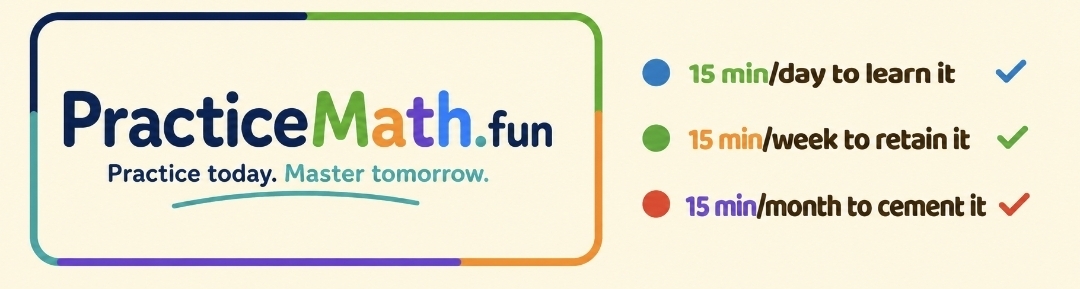
PracticeMath.fun — Practice today. Master tomorrow. Fifteen minutes a day to learn it, a week to retain it, and a month to cement it.

*Patent Pending

For Parents

Everything you need to help your child build stronger, faster, and more lasting math skills.

1. Why Is My Child Struggling in Math?

When students are learning a new math procedure—such as 427 ÷ 7, 27 × 6, or 16 × 17—their mental effort needs to be focused on learning and remembering the steps of that procedure. Basic facts such as 6 × 7 should be recalled automatically, like second nature. If a student is instead using that mental effort trying to remember whether 6 × 7 is 42, 48, or something else, not only will the problem take much longer to complete, but less attention is also available for the new procedure—and one incorrect basic fact will make the entire answer wrong.

2. How PracticeMath.Fun Works ⭐

PracticeMath.Fun uses our proprietary algorithm to focus practice, isolate unknown facts, provide immediate feedback, and use timed repeated recall to strengthen the facts your child needs most. The goal is not endless repetition—it is efficient, targeted practice that leads to fast, accurate recall. The timed-response element keeps practice moving at an efficient pace and helps build the recall speed expected in the classroom, so your child is not lagging behind while other students are already moving on to the next step of the problem.

3. Why Fast, Accurate Math Facts Matter ⭐

Basic math facts are the building blocks of more advanced math. Consider 427 ÷ 7. If your child instantly recognizes that 6 × 7 = 42, most of the work is already done, and the problem can often be solved mentally. But if 6 × 7 is not readily available from memory, your child may spend one, two, or even three minutes using repeated addition or skip counting just to find 42. Meanwhile, other students are moving on to the next problem—and few things are more discouraging to a child than feeling left behind.

Now consider 16 × 7. Solving it efficiently requires not only knowing that 6 × 7 = 42, but also being able to add 7 + 4 quickly and accurately. A child can spend considerable time working out 6 × 7, follow every step of two-digit multiplication correctly, then make a simple error on 7 + 4—and after all that time and effort, still get the entire problem wrong. Imagine how frustrating and defeating that must feel!

4. What Math Should My Child Know at Each Grade?

By middle school and high school, basic addition, subtraction, and multiplication facts should be fast, accurate, and automatic. Yet, the reality is, many older students still count on their fingers, skip-count to multiply, or simply recall basic facts incorrectly. These students are being asked to learn increasingly more complex mathematics while still struggling with the arithmetic underneath it.

Ask your child 8 × 7. The answer, 56, should be recalled accurately within five seconds. Similarly, if you ask 7 + 8, the answer 15 should come automatically.

When basic facts are not secure, every new math procedure becomes slower, harder, and more prone to error. Before moving ahead, make sure the foundation is truly there.

5. How Can I Help My Child With Math?

Start by making sure the foundation is solid. If basic facts are slow or inaccurate, more advanced math will only become harder. Keep practice short and consistent—15 focused minutes a day on PracticeMath.Fun is enough to comfortably complete one full Practice session and one Test.

Our recommendation is to master one operation at a time. For elementary students, start with addition, then subtraction, followed by multiplication. For older students, start with multiplication, then addition, subtraction, integers, and exponents.

Continue daily practice until your child earns 100% on the Test. If a careless mistake occurs, they can pause and restart the test. From your Parent Dashboard, watch the percentage of Practice completed, the latest Test score, and the number of pauses used. Frequent pauses may mean your child is stopping to work out answers rather than recalling them automatically—in that case, spend the full 15 minutes on Practice before testing again. Use History to follow improvement over time.

Once your child reaches 100% accuracy, continue daily practice until answers are recalled in about 5 seconds or less. Then move that operation to a weekly Test while beginning the next one. If a weekly score drops below 100%, return to Practice and Test until mastery is restored.

Once all operations are mastered, a monthly review session is usually enough to help keep those facts fast, accurate, and secure over time.
6. Accuracy Before Speed ⭐

Speed should come after accuracy. First, your child should consistently recall the correct answer; with repeated practice, that correct response gradually becomes faster and more automatic.

7. Why Does My Child Know It Today and Forget It Tomorrow?

Learning something once does not mean it will stay learned. Revisiting information over time strengthens memory and helps move a skill from temporary learning to long-term recall.

8. How Much Should My Child Practice?

Short, regular practice is usually more effective than occasional long sessions. PracticeMath.Fun recommends about 15 minutes a day while learning, then less frequent review as the skill becomes secure.

9. Where Should My Child Start?

Start with the earliest skill your child cannot recall accurately and comfortably. Strengthening that foundation first makes everything that comes afterward easier.

10. Should Kids Memorize Math Facts?

Children need both understanding and recall. They should understand what multiplication, addition, subtraction, and division mean—but frequently used facts should eventually become automatic.

11. Building Math Confidence in a Child Who Struggles

Confidence grows when children experience real success. Smaller goals, visible improvement, and practice at an appropriate level can help replace “I’m bad at math” with “I can do this.”

12. Why Timed Practice?

Timing helps measure how easily a fact can be recalled, not simply how fast a child can work. Used appropriately, it can show when answers are becoming automatic and identify facts that still need practice.

13. How PracticeMath.Fun Helps With School Math

Fast recall of basic facts reduces the mental effort required for long division, fractions, integers, algebra, and many other topics. Strong fundamentals give students more attention to devote to the new concept being taught.

14. How Quickly Should I Expect Improvement?

Every child starts from a different point, so progress will vary. Consistent short practice usually matters more than long sessions, and improvement should be measured over time rather than from one practice session to the next.

15. Keeping Math Skills From Fading

Mastery means more than answering correctly once. A student should recall facts accurately, consistently, and with little hesitation before moving on. A 100% test score, completed without pauses and with an average response time of around 5 seconds, is a strong indication that mastery has been achieved. Once accuracy is secure, continued practice can strengthen recall speed and long-term retention.

16. When Is My Child Ready to Move On?

A child is ready to move on when answers are consistently accurate and can be recalled without excessive hesitation. Moving forward too early can leave small gaps that become larger later.

17. What Does “Mastery” Mean?

Mastery means more than getting an answer right once. A mastered fact can be recalled accurately, consistently, and with little effort—even after time has passed.

18. Track Your Child’s Progress

The Parent Dashboard helps you see what your child is practicing, how they are performing, and where they may still need support. It turns practice results into useful information you can act on.

Ready to help your child master math facts?